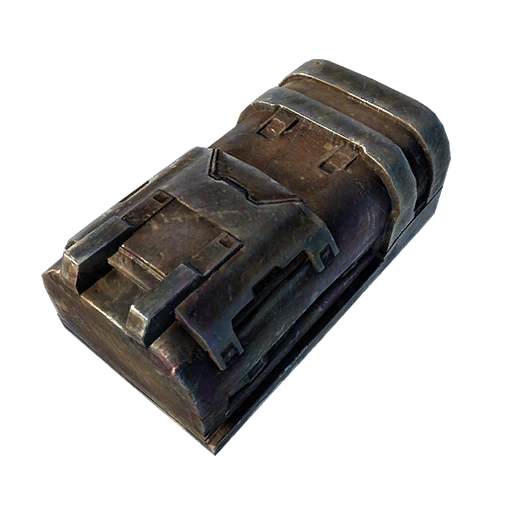

The Stasis Module in Dead Space (2023).
- "Reminder: an engine in Stasis is a safe engine."
- —Poster on the USG Ishimura.[1]
A Stasis Module is a supplementary accoutrement to a RIG suit. The device is capable of producing a temporary time dilation, making objects move at an extremely slow rate for a period of time.
Overview


A sign warning workers about misusing Stasis on the USG Ishimura.
Stasis is a field of science and technology based on advanced quantum physics. In layman's terms, "Stasis" modules allow the suspension of a field of "slowed" time in a designated volume. All motion and physical activity "slows" relative to normal time.
It was initially suspected that living organisms subject to such a temporal slow down would die, as aerobic and anaerobic activities, vital to life, would be affected. However, Stasis merely shifts the afflicted into a slower "state" of time; bodily functions relative to the afflicted individual(s) still work (relative to their temporal state), and hence, they do not come to harm.
That said, Stasis has found wide applications in the surgical field, where patients who are suffering from otherwise terminal conditions or incredible trauma (such as the loss of whole limbs) can be put into Stasis while suitable equipment and staff are assembled and organized to render treatment.[2]
Commercially, Stasis is used to slow down dangerous malfunctioning equipment until it can be repaired or replaced. Judging from its use in the P-Sec and Soldier RIGs, it is also apparent that the Stasis Module is used as a non-lethal weapon when apprehending dangerous criminals, presumably freezing them temporarily so that they can be handcuffed.


A poster advising engineers to use Stasis on the USG Ishimura.
Stasis Energy can be monitored via an all-purpose indicator embedded in the RIG suit's armor, covering the user's right shoulder blade. It appears as a bluish half-circle to the right of the health indicator, which drains as Stasis Energy is fired. Its energy efficiency and duration can be upgraded with Power Nodes via workbenches, just like all other equipment. To recharge Stasis, Isaac Clarke must either use Recharge Stations scattered about the environment or use Stasis Packs picked up and stored in the inventory. In Dead Space 2 and Dead Space 3, Stasis slowly recharges by itself over time.
Stasis with Consciousness
- "The containment module, for example - remember your last brain surgery? Stasis with consciousness, quite useful. If only I hadn't wasted so much osmium on my last module design..."
- —Dr. Challus Mercer to Brant Harris.[3]
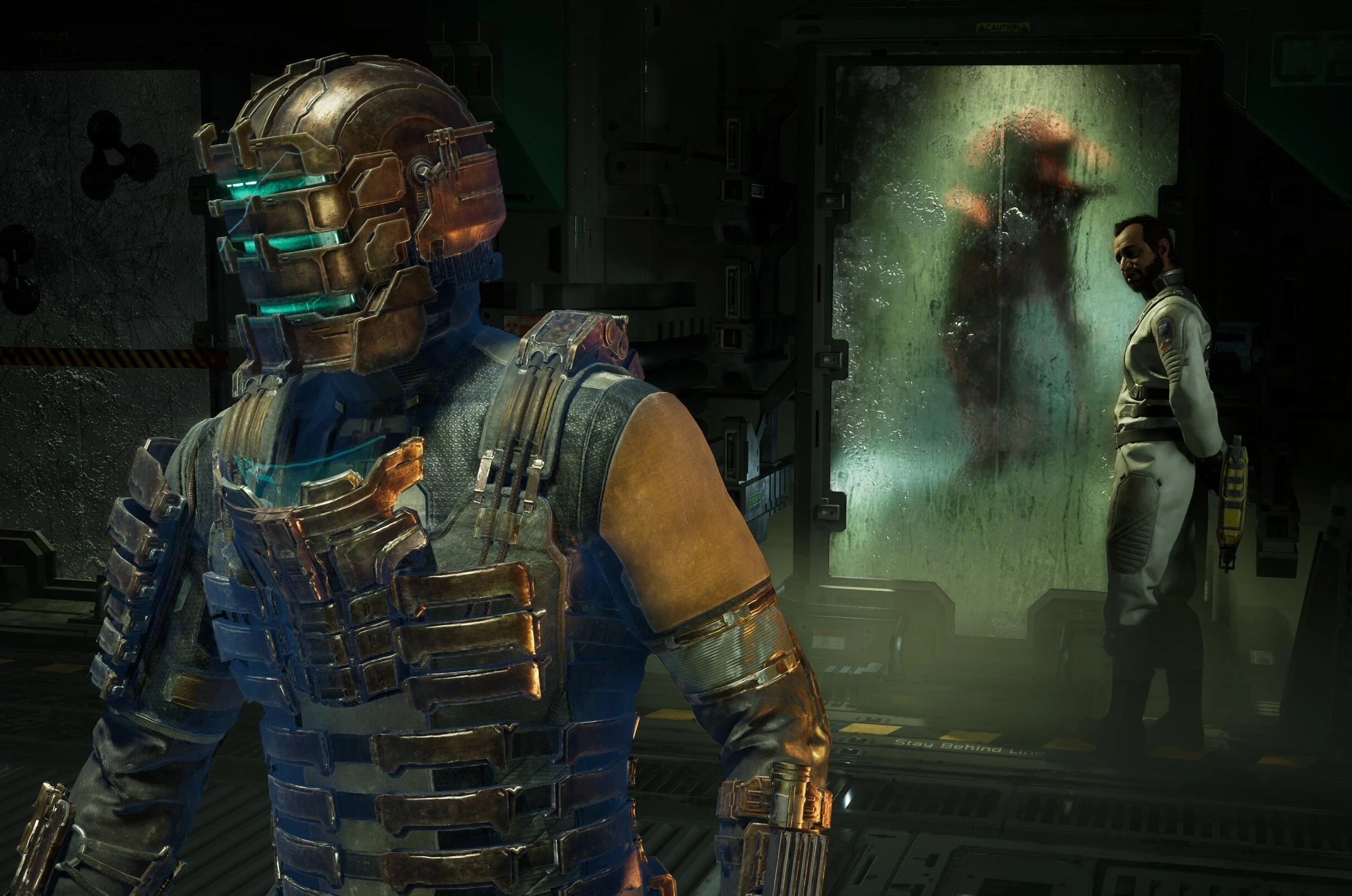

Dr. Mercer talks to Isaac Clarke after using his specialized "Stasis with consciousness" on him.
Prior to and during the Necromorph outbreak on the USG Ishimura in 2508, Dr. Challus Mercer constructed an advanced Stasis Module that he would use in his experiments, using a large quantity of osmium that the doctor sent Brant Harris to collect from the Mining Deck.[4] Contrary to other forms of Stasis, the field developed by Mercer allowed the afflicted individual to retain their consciousness and awareness relative to "normal" time while the rest of their bodily functions were slowed, a process that Harris described as very painful after Mercer used it on him to perform brain surgery.[3]
- "It's a slow death, in Stasis."
- —Dr. Mercer while killing Jacob Temple.[1]


Mercer kills Jacob Temple after immobilizing him with his Stasis Module.
Dr. Mercer most notably used his special Stasis Module on Jacob Temple after Temple attempted to kill the doctor. Immobilizing Temple's body while keeping his consciousness, Mercer fired a bolt from his Rivet Gun into Temple's brain, forcing him to experience a slow and extremely painful death as the bolt pierced his head in Stasis.
Appearances
Dead Space


The Stasis Module attached to Isaac Clarke's left forearm and hand.
The Stasis Module is found in the first chapter of Dead Space. Once obtained, the Stasis Module becomes a permanent part of Isaac's equipment. It appears as a band secured to Isaac's left forearm via three metal straps, with a secondary component secured to the back of his hand via an attached glove slip. The arm and hand elements each have a short cylindrical part that presumably aid in focusing the aim of the stasis bolt.
Upgrades can be done using Power Nodes, allowing for more Stasis Shots and greater duration of a single application. Later on in the story, it is revealed that EDF Marines, such as the ones on the USM Valor, have Stasis Modules built into their RIGs. When transformed into Necromorphs, the modules merge into the flesh and the Stasis is somehow reversed, dramatically speeding up the newly created monster, rather than slowing it down. This is why Twitchers exhibit their odd rapid twitching behavior.
Dead Space: Extraction
In Dead Space: Extraction, the Stasis Module is obtained in the Megavents in the first chapter, becoming a permanent part of the player's arsenal. It has a three-time use before a period must be spent recharging, the speed of which is upgraded after enough stars are earned after the completion of each chapter. It serves the same purposes as in the main games: to defensively stop approaching enemies and to slow dangerous environmental roadblocks.
Dead Space 2
The Stasis Module is found in the first chapter of Dead Space 2, when Isaac unplugs it from a terminal in a hospital CT room in order to slow a door down. Unlike in the original Dead Space, Stasis will regenerate over time, but the player can still use Stasis Packs for a full recharge if needed. Stasis Packs can now be used instantly via a hotkey instead of being manually selected from the inventory. Upgrades can be done to improve charge, increase duration, and shorten the recharge time period.
A fully upgraded Stasis Module takes 400 seconds to refill or 100 seconds per section. If the CHR Nodes are filled, it takes 320 seconds (or 80 seconds per section) to refill. Using the Advanced Suit halves the time to 200 seconds (50 seconds per section) and 160 seconds (40 seconds per section).
Dead Space 3
The Stasis Module, like the Kinesis Module, is unavailable in the prologue chapter, yet becomes available as soon as the player gains control of either Isaac Clarke or John Carver (in Co-Op) in the first chapter. Like in Dead Space 2, it will regenerate over time and can be recharged using Stasis Packs.
Unlike the previous two games, the Stasis is no longer upgraded with Power Nodes at a bench. In Dead Space 3, it can only be upgraded at a Suit Kiosk, using the various materials found throughout the game. As the game no longer features suits with various bonuses, the Stasis Module's recharge time can only be lowered through upgrades and will be the same when using any suit.
Stasis is now available to the enemies of the game as well. The various members of the Circle often throw Stasis grenades at the player, which if detonated within close proximity will slow them down for a few seconds. Due to the time delay detonation however, the same grenades can be picked up using kinesis and thrown back at the enemy, slowing them down instead.
Later on, Isaac and Carver will encounter Stasis Amplification Fields in the Alien Machine that, when stood upon, greatly augment their Stasis Module's duration and debilitation effect. Targets under the effects of Super-Stasis also have a slight orange-green glow to them.
The Cult Leader in the Awakened DLC has a Stasis module in his possession that he will occasionally utilize during his boss fight in order to hamper Clarke/Carver's movement, allowing him to close in and attack. The duration of his Stasis shots are about the same as a third-way (30%) upgraded Module.
Strategies and Tactics
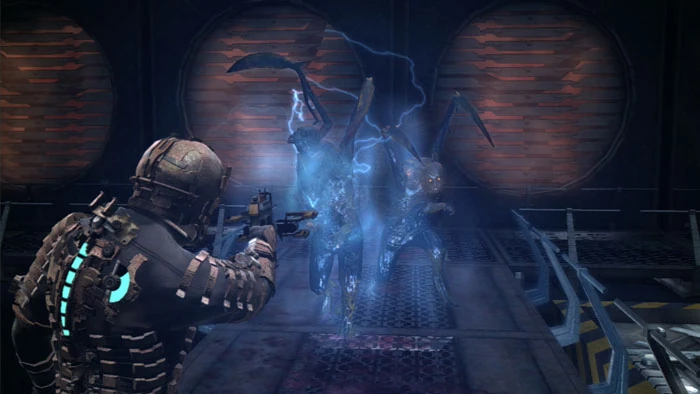

Two Enhanced Slashers under Stasis.
- Upgrading the ENG attribute at a bench will fully recharge the Stasis charge.
- The stasis bolt takes the form of a blue ball of energy that releases Stasis when it makes contact with something. The Stasis not only affects whatever it hits, but also anything in a small area around it, which makes it considered a "splash" weapon. If you see a group of Necromorphs, aim at the middle of the group and fire stasis to freeze every creature. Care must be used since the Stasis 'bullet' takes some time to hit a target at a distance.
- If you are in a room with a Stasis Recharge Station, feel free to use Stasis to your heart's content, as you have unlimited recharges.
- During the latter chapters of Dead Space 3, the TK plate can be extremely helpful when fighting Necromorphs, as the enhanced Stasis module is significantly upgraded, lasting up to 15 seconds or more of the effect, and each shot uses less of each Stasis Pack, increasing its capacity while on the TK plate.
- From a tactical standpoint, Stasis Energy should be reserved when fighting the more dangerous Necromorphs like the Hunter, Twitchers, Exploders and Brutes. It can also be used with great effectiveness against closely bunched lesser Necromorphs such as Swarmers.
- Necromorphs can still do damage if in an attacking posture when Stasis was invoked. Also, projectiles like Lurkers barbs cannot be placed in Stasis– but a Lurker in the throes of the Stasis effect will not be able to get a bead on Isaac if he keeps moving.
- In Dead Space, Stasis can be recharged by opening the pause menu and inputing:
- Square, Triangle, Triangle, Square, Triangle for the PlayStation 3 version.
- X, Y, Y, X, Y for both the Windows and Xbox 360 versions.
- In Dead Space 2, there are Stasis Canisters which will slow down your enemies with exactly the same effect as using a Stasis Bolt from the Stasis Module. They are identified by their large cylindrical shape and blue color scheme. They also contain what appears to be a miniature Stasis singularity inside the canister. These canisters can be picked up with Kinesis and thrown in the same way as other environmental objects.
Trivia
- Stasis comes from the Greek word "στάσις" which means "immobility".
- In Dead Space 3, weapons crafted with a Stasis Coating module attached will coat targets with a small amount of Stasis energy upon hit. If this module is used in conjunction with a rapid firing weapon such as a Ripper or Flamethrower that was sufficiently upgraded, any hapless Necromorph caught in the flame jets/saw discs will be rendered immobile until they die, or until the weapon's magazine is depleted, though the latter is hardly the case.
- The Stasis Module in Dead Space is acquired before Isaac obtains the Kinesis attachment and is positioned behind it. In Dead Space 2 this is reversed, as Isaac now comes across the Kinesis machine much sooner than the Stasis mechanism, and when viewed on the Patient Suit, it seems that the Stasis canister is positioned in front of the Kinesis Module rather than behind it.
- A Stasis unit does not require a full-body RIG to use; in Dead Space: Extraction, Nathan McNeill wears a wrist-mounted Stasis unit operated using pulleys worn over his fingers.
- Most suits in Dead Space 2 have the wrist portion of the left gauntlet covering the module (and by extension, the entire Kinesis attachment).
- In Dead Space, there was an available cheat code that granted the player a full refill to the Stasis charger. This feature was removed from Dead Space 2 presumably due to exploiting reasons, as the cheat code negated the need for any sort of upgrades and the need to carry a portable charger, and would have also made the "Hard Core" mode too easy. However, there was also a cheat code that granted the player a full refill in the O2 charger. This cheat had exploiting consequences as well in Dead Space, although proving to be a far less effective cheat than the "Stasis" one. However, the portable O2 chargers are no longer available in Dead Space 2.
- In Dead Space, there is a very low chance that you can find a Stasis recharge in the supply boxes found in the room where the player obtains the Plasma Cutter. Oddly, the player can use it even before the Stasis module is obtained later in the level and is capable of firing Stasis from Isaac's arm without using the Stasis Module.
- Using a cheat to get an instant Stasis refill will also give the player a full Stasis Meter, however it cannot be used until the actual module is acquired.
- The medical use of Stasis is exemplified in the Co-Op experience of Dead Space 3. There exists an achievement/trophy for using Stasis on your partner while they are downed.
- This is actually useful, as Stasis will prolong the bleedout period of your partner, possibly allowing you to reach them and save them, or giving you some more time to clear out the area of hostiles for a safe revival.
- The achievement/trophy is only available once the Awakened DLC is installed. Likewise, your partner can only be put under Stasis if the DLC is present in your computer/console hard drive.
- The blue glow of the projectile could be attributed to Cherenkov Radiation, a byproduct of particles moving faster-than-light. As speed towards light (abbreiated "C") increases, time begins to slow. Tachyons, theoretical particles that move faster than C, would actually be going backwards in time. It may be that Stasis coats targets in a film of tachyons moving ever so slightly FTL.
Gallery

Sources
| ||||||||||||||||||||||||||