- "It is unlikely that a race as advanced as this one would have remained bound to just one planet. Indeed, there is evidence to suggest their empire was widespread, spanning many star systems. They must have been trillions-strong before falling to the Markers. And perhaps that is the point. Allow a species to thrive until they are so many in number that they can no longer sustain themselves… then descend upon their worlds to feed."
- —Dr. Earl Serrano[1]

Overview of one of the aliens.
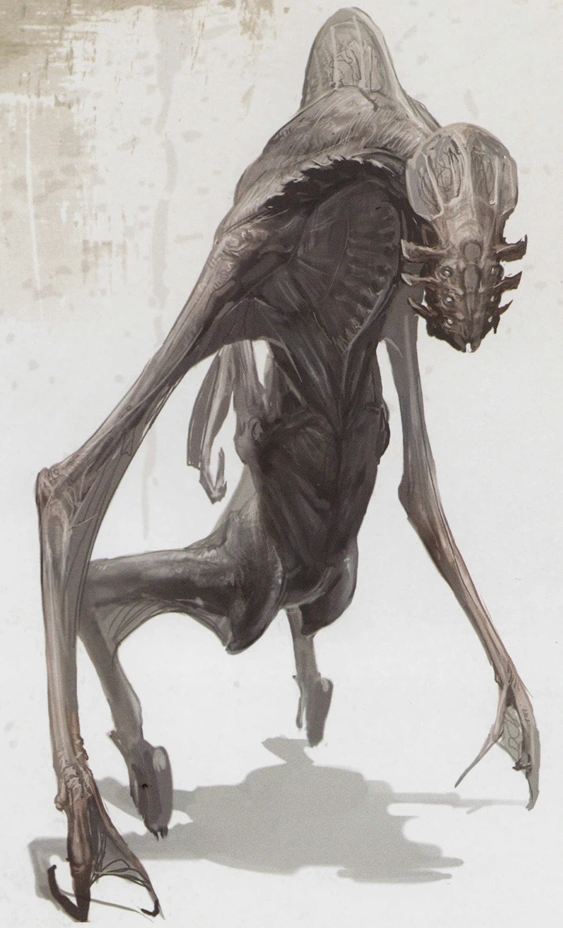
This semi-aquatic alien race once had an advanced civilization on their native planet of Tau Volantis where, two million years ago,[2] they discovered a Black Marker and fell victim to its compulsions.
History
Marker Discovery and Replication
- "The aliens, they... They found the Markers, just like us - and it spread. It consumed them..."
- —Isaac Clarke
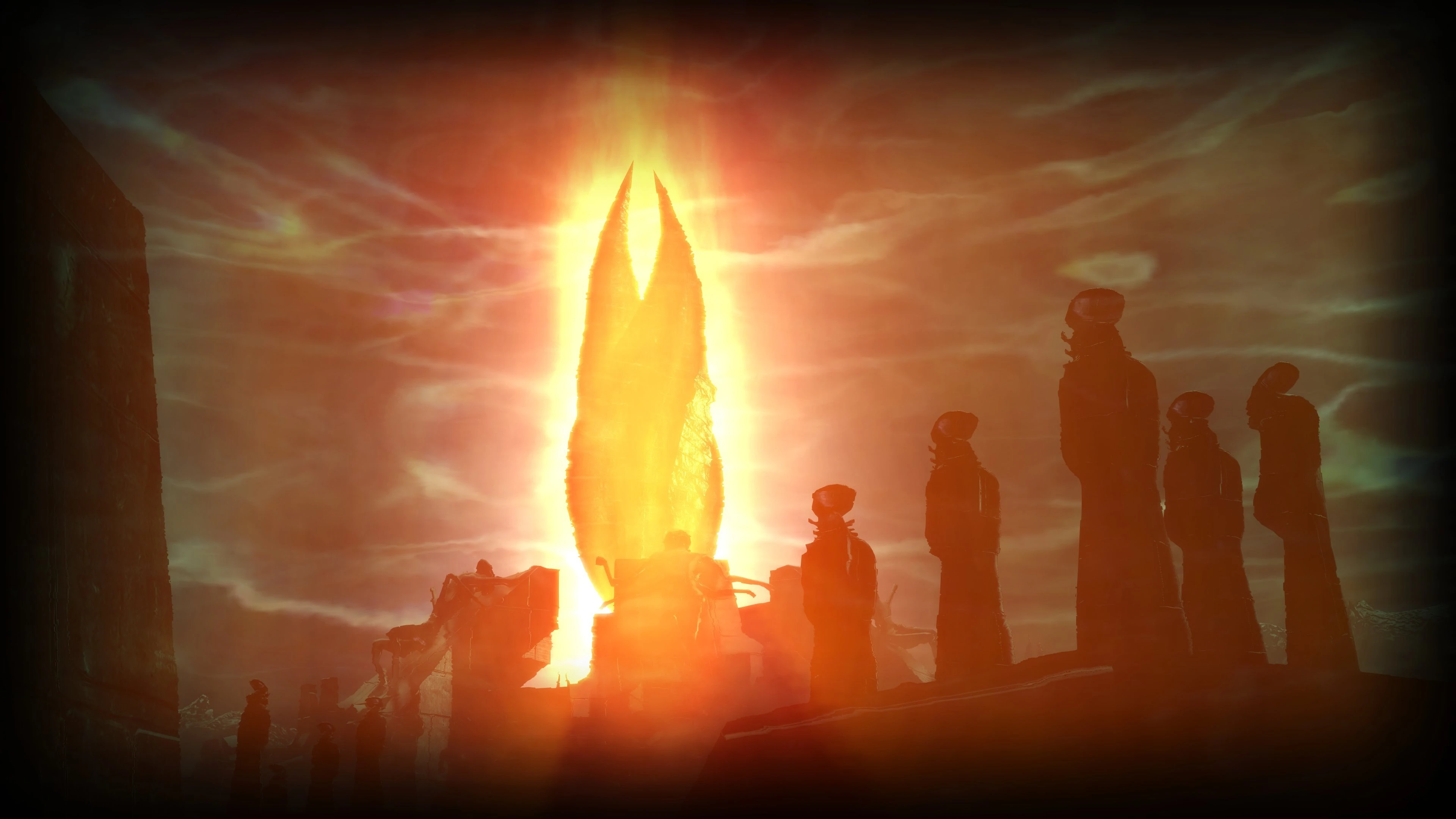
The aliens gaze in awe as the Black Marker unexpectedly begins a Convergence Event.
Over two million years ago, a technologically and socially advanced alien species inhabited the vast water-covered planet of Tau Volantis. At some point in their history, they discovered a Black Marker similar to what would later be discovered on Earth. The civilization began to replicate the Marker, likely due to both religious furor its signal induced and as a practical source of limitless energy. The aliens built Marker copies across the planet's surface.
Tau Volantis First Convergence Event
- "The signs are all around me. I don't know why I didn't see it before. Everywhere we look there are Markers; red ones similar to the copies we ourselves have created back home. The Marker signal doesn't just reanimate the dead. It manipulates us into spreading the Markers. [...] It is no wonder Tau Volantis chose self-sacrifice. They eliminated themselves like a gangrenous limb, hoping to keep the infection from spreading to us."
- —Dr. Earl Serrano[3]
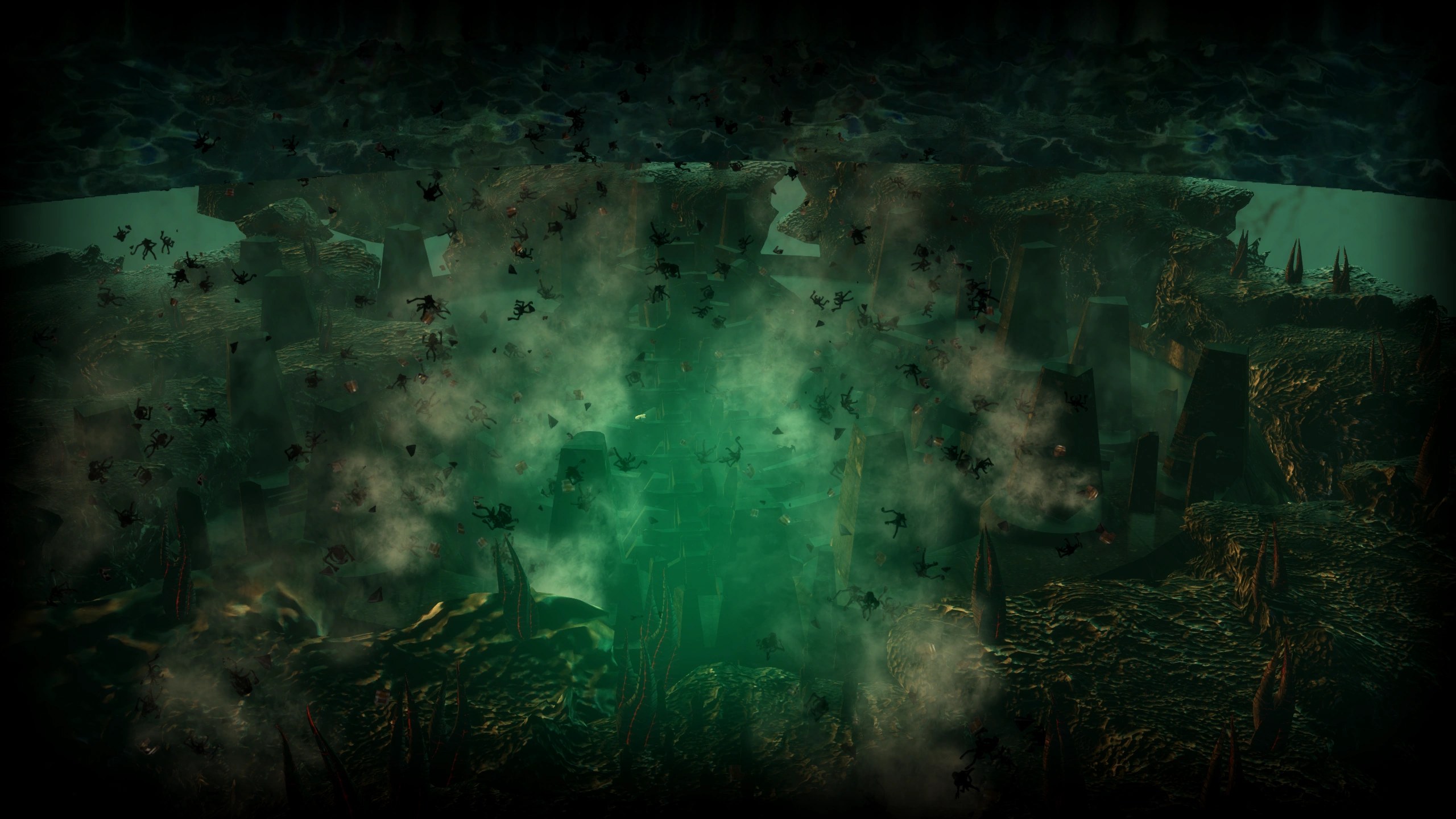
The aliens' bodies are used for Convergence following a Necromorph outbreak.
Eventually, a Necromorph outbreak began, converting enough of the aliens that a Convergence Event was triggered, pulling the majority of the biosphere into orbit to form a Brethren Moon. At least some faction of the species was aware of the danger, however: in an act of sacrifice, they constructed a massive Machine that instantly froze the planet along with the Moon, leaving the colossal Necromorph incomplete and inert. The Machine failed to destroy the Moon, however, allowing the Moon to project its signal through the Markers still spread through the galaxy, as well as broadcast a message pleading for the Machine to be disabled: "Turn it off."
Legacy
- "Everywhere we dig, we find them, their frozen carcasses trapped in the ice. I know Serrano says they've been dead for two million years but I can't shake the feeling that some part of them is still alive. Their eyes, if they had them, are long gone. But their stares are intense. Accusing. Angry. Distorted. And around them, always the Markers: Ancient monoliths from an ancient race. Sometimes, when everyone has left the dig site for the day, I hear their icy voices like whispers on the wind. 'Turn it off. Turn it off.'"
- —SCAF Private Edmund Varley[2]
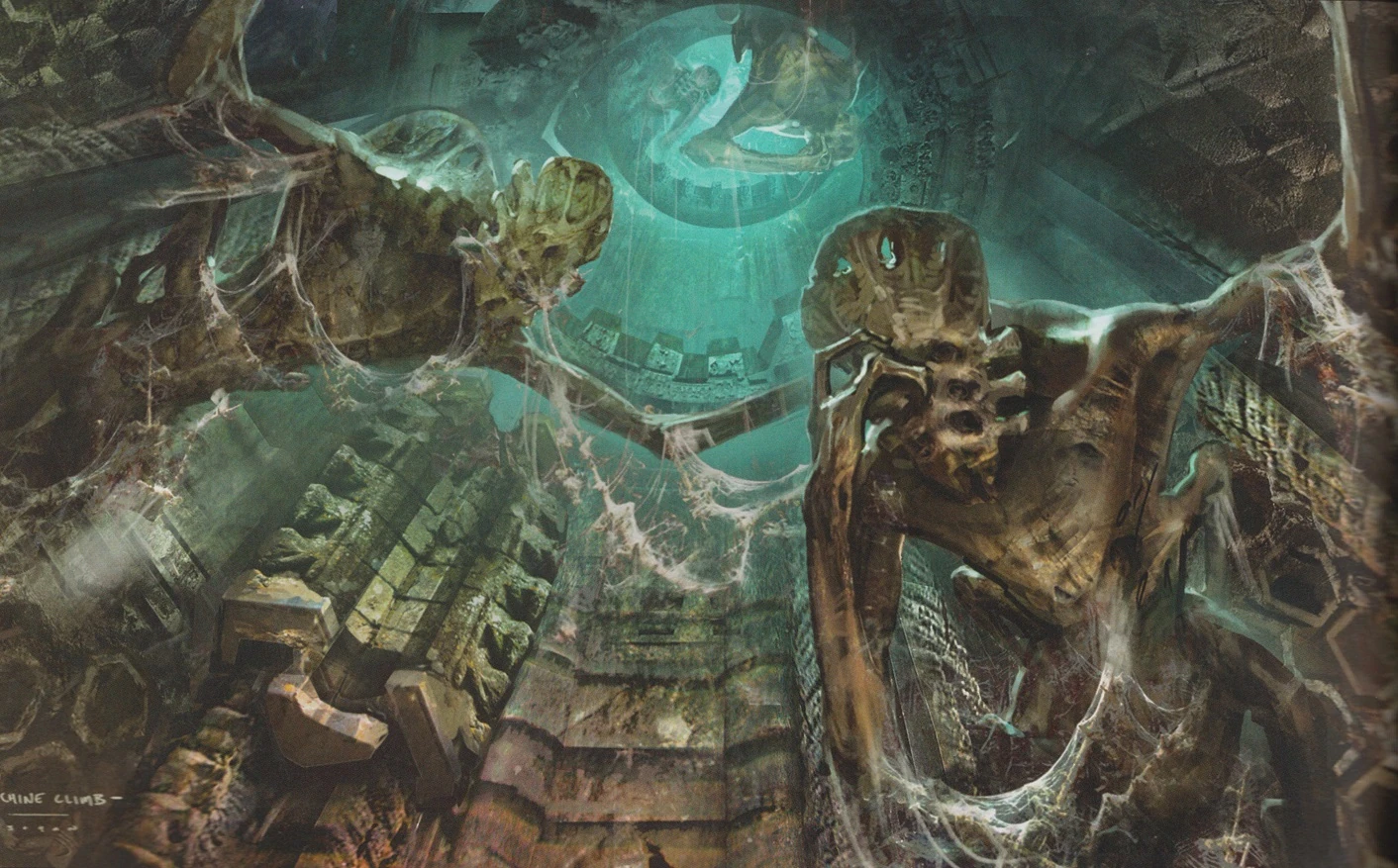
The remains of the alien civilization at the heart of their Machine.
Two million years later, in the year 2311, the Sovereign Colonies Armed Forces discovered the planet and the remains of an alien specimen that they called "Rosetta". After studying "Rosetta", Dr. Earl Serrano discovered the truth and tried to complete the aliens' unfinished work of using the Machine to destroy the Moon, but in 2314, General Spencer Mahad received orders invoking a purge of all of the personnel, information, and assets on Tau Volantis before Serrano could get the Codex required to complete the process of the Machine.
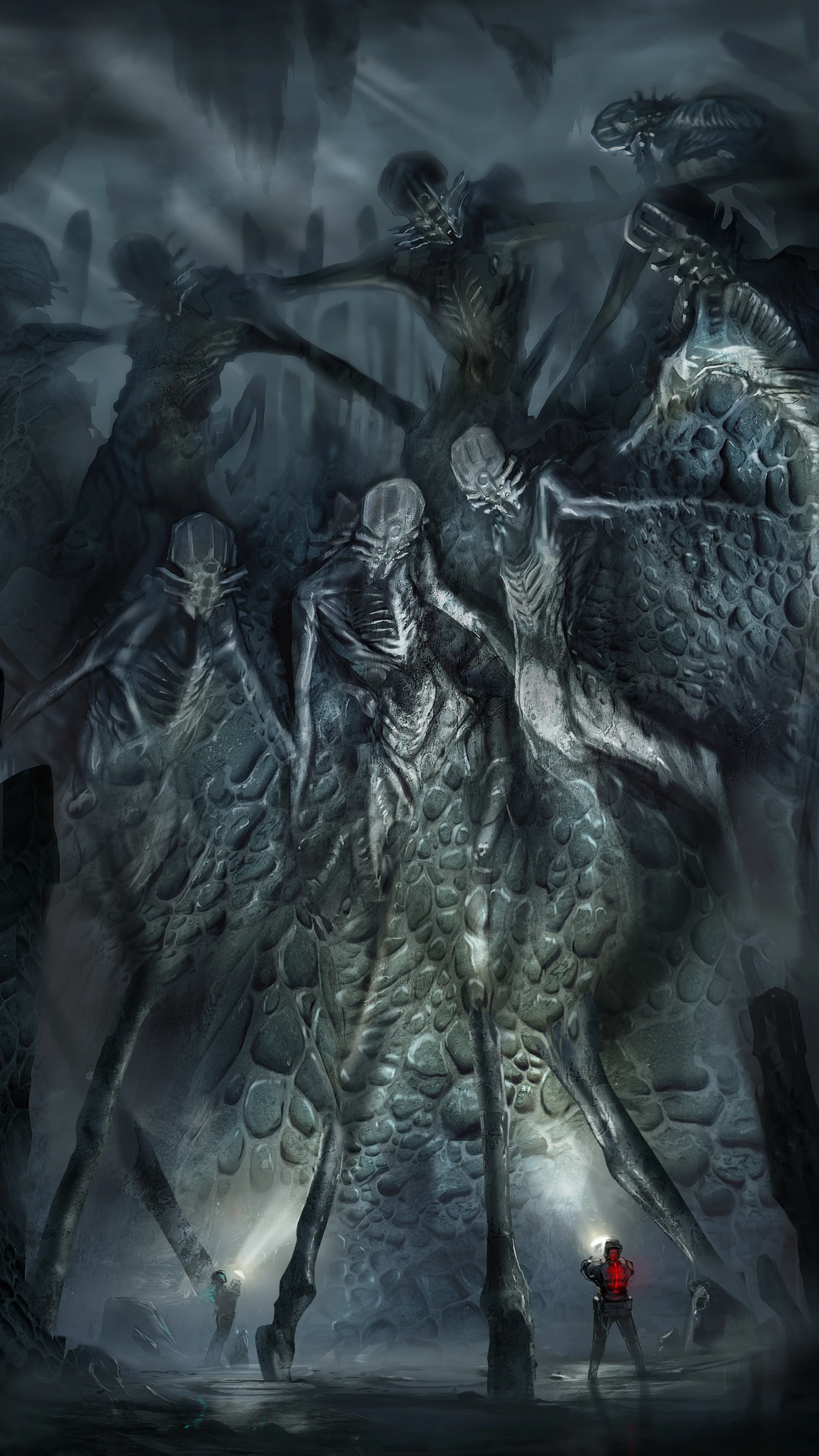
Isaac Clarke and John Carver discover the remains of the aliens in 2514.
- "The natives of Tau Volantis, like ourselves, tampered with the Markers and broke from Nature's plan. Judging by the relative completeness of the Moon in orbit, they were so close to achieving final, lasting glory. Now we are faced with their test. Will we too fall short of eternal glory because we stopped mere inches from the final stage? Will we also succumb to fear and fail to take the last step? Faith takes courage, my friends. Today, let us be the ones to set aside fear and accept the future promised by the Markers."
- —Unitologist Circle leader Jacob Arthur Danik[4]
200 years later, in 2514, an expedition led by Isaac Clarke - pursued by Unitology fanatics under Jacob Arthur Danik - rediscovered "Rosetta" and unlocked knowledge of the lost species and their technology. Isaac used this knowledge to fulfill the aims of Serrano and the aliens: finally kill the Moon using the Machine and stop the threat of the Markers. Despite their best efforts, however, the expedition was unable to prevent the remaining Brethren Moons from making their way to Earth to consume its population.
Anatomy
- "It appears that all the specimens share common features that are quite suprising: gills! Along with what I presume are swim bladders and collapsible fins. This is quite improbable for a frozen wasteland... unless it was not always frozen. I now believe this planet was once a vast liquid ocean, and that a single, sudden event caused a flash freeze, trapping everything in the ice."
- —Dr. Earl Serrano[5]

The alien anatomy as seen in Dr. Serrano's journal.
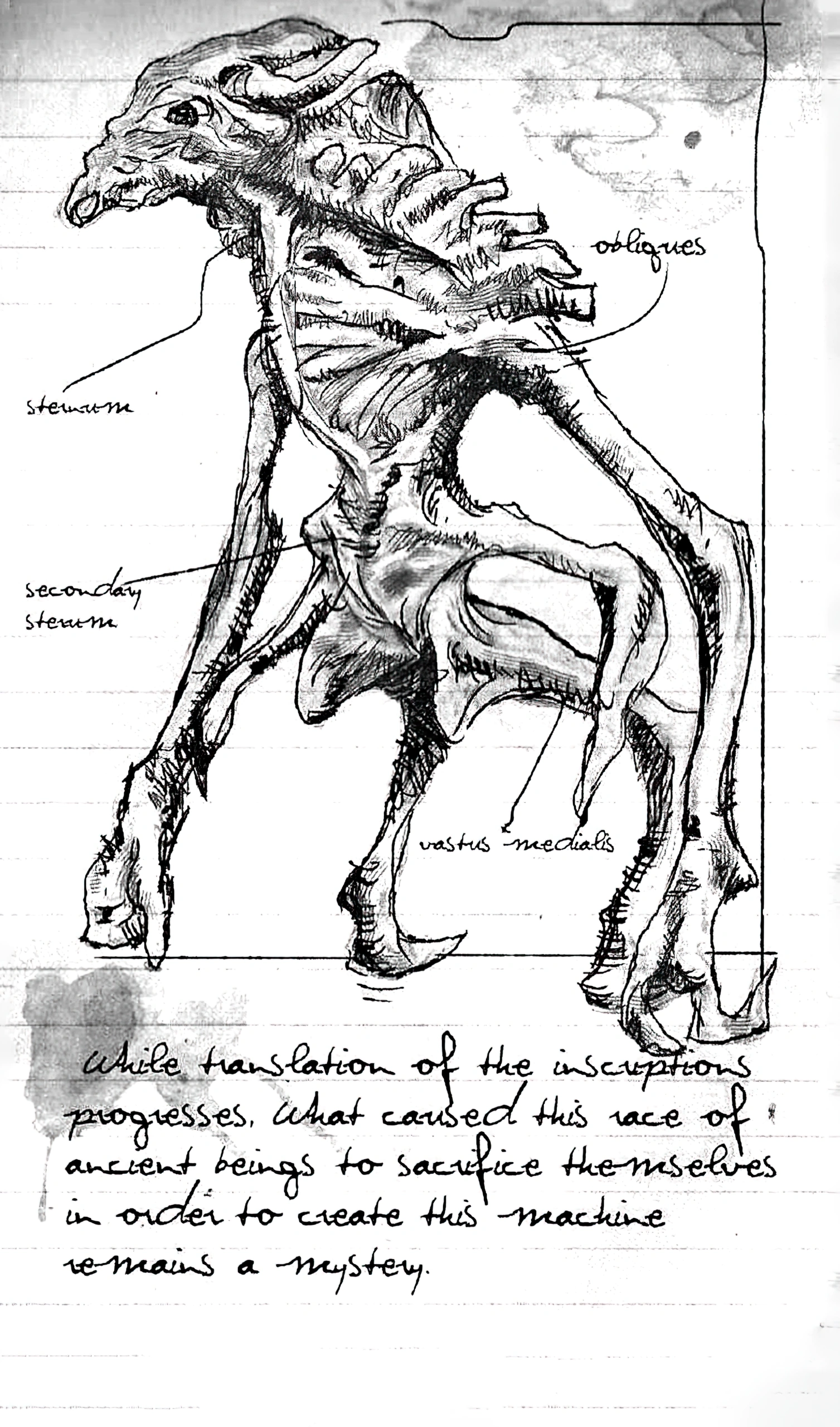


The aliens' anatomy was described extensively by the studies and notes of Dr. Earl Serrano, collected from the data found within the frozen body of Rosetta, one of their kind, and amongst calcified bodies found within the underground city that circled the Machine.
The aliens were mostly fish-like in nature with gills and collapsible fins which allowed Dr. Serrano to deduce that the planet had at one point not been covered in ice, but a vast ocean. They appeared to be semi-aquatic, as they were able to live a terrestrial lifestyle in cities. They were hexapods, with one primary pair of clawed-forelimbs and a smaller pair protruding from underneath the torso, and a pair of backwards-facing hindlimbs. They had flat, elongated skulls with various grooves and bone-like growths resembling something of a crest. Infant aliens resembled their adult counterparts, having a flat grooved skull, and were roughly the size of human infants. Their limbs were also smaller and underdeveloped.
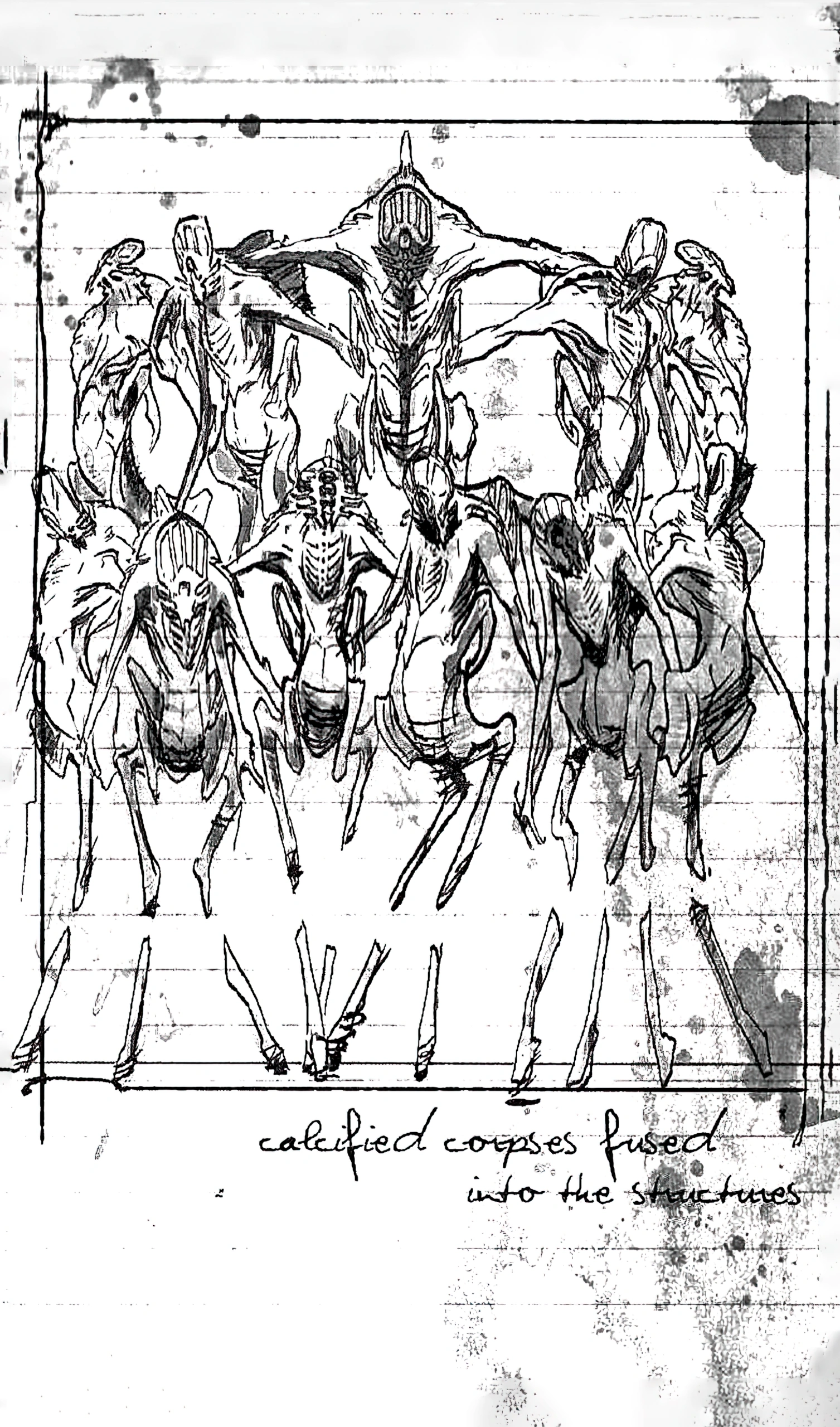

Giant, calcified aliens as seen in Serrano's journal.
According to Serrano's research, the aliens communicated with six holes within their skulls that let out harmonic noises with a similar cranial design as human nasal passages. He deduced, however, that this was not their primary language form and this method was developed by the aliens to allow a form of cross species communication. This pseudo-language was created to convey information to any beings that found their culture long after their extinction.
The creatures were described and shown as varying in size, ranging from four meters in height to twenty-stories tall.[6] The calcified remains of dozens of building-sized aliens could be found surrounding the Machine.
As Necromorphs, the torso of the aliens split open, allowing them to launch their reanimated offspring at their victims. Tusk-like growths burst from underneath the skull, allowing the creatures to ram and gore their prey. Like with human Necromorphs, their flesh was mottled and decomposing.
Trivia
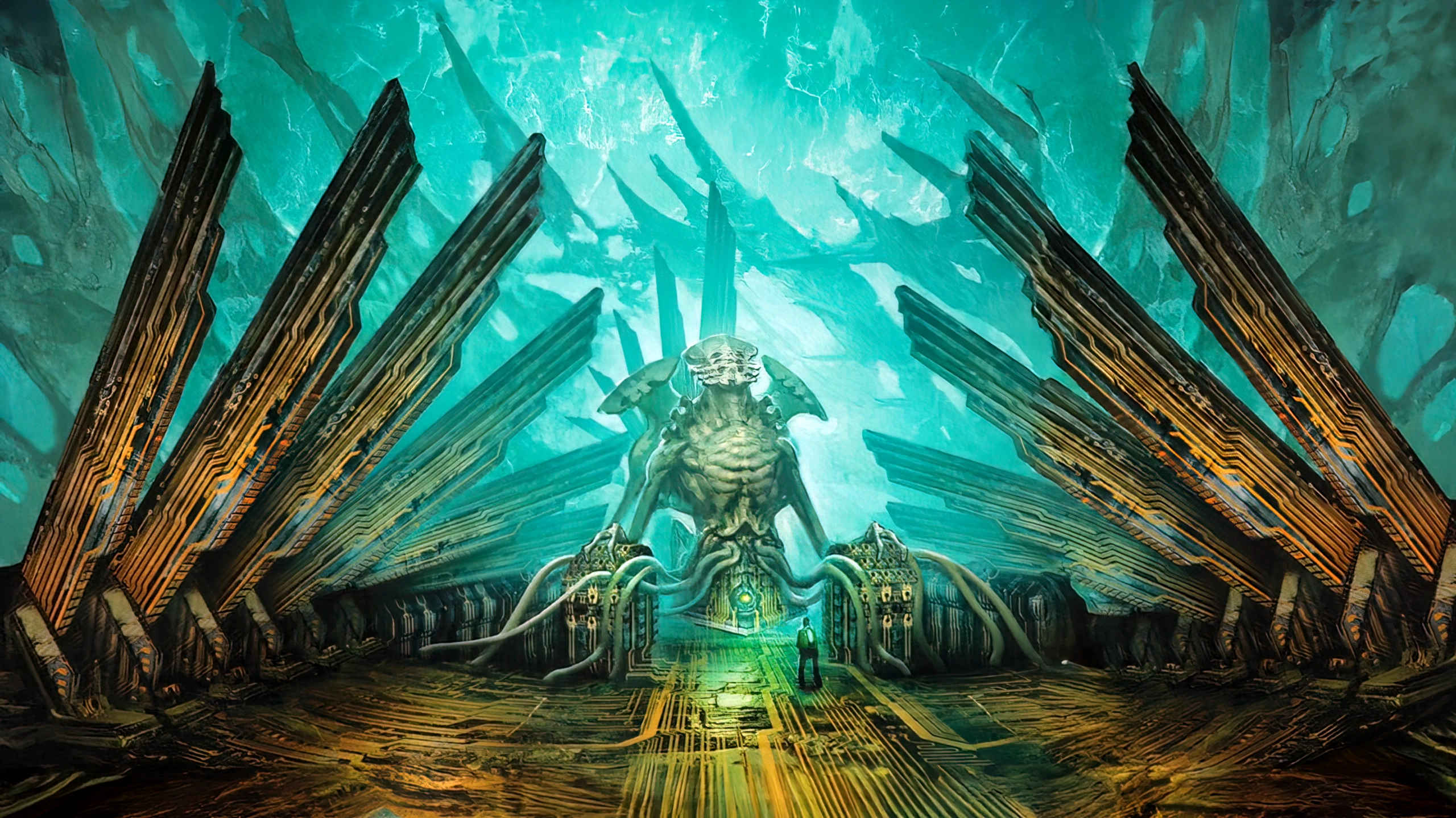

The heart of the Alien Machine.
- According to The Art of Dead Space, the aliens' architecture and their Machine are an explicit homage to the derelict alien ship from Ridley Scott's 1979 film Alien.
- The head of the aliens heavily resembles that of the Xenomorph Queen from the 1986 film Aliens, its likely inspiration. Coincidentally, it also bears a slight resemblance to the Unitologist Enigma masks.
- During Dead Space 3, players will encounter Necromorph variants of the aliens. These Necromorphs, according to Dr. Serrano, were thawed out of ice by the biology team as they attempted to communicate with them, unaware that they were infected monsters and not the alien lifeforms themselves. It is most likely that these alien Necromorphs rekindled the infection in June 2314.
- The aliens' technology (most notably the Machine) would only function with the species' pure DNA. Serrano commented on this when realizing the Machine would not work with a Codex programmed by the DNA of an alien-turned-Necromorph; thus explaining why "Rosetta", frozen solid and preserved from the Necromorphs, was so vital to the project.[8]
Gallery
Dr. Serrano's Journal Entries


Other


Sources
- ↑ Log:Alien Artifact 07
- ↑ 2.0 2.1 Log:Alien Artifact 02
- ↑ Log:Alien Artifact 08
- ↑ Log:Unitologist Artifact 06
- ↑ Log:Piece: Gills
- ↑ Log:Alien Artifact 06
- ↑ Dead Space 3 Prima Guide
- ↑ Log:Piece: Brain